Traditional CMSs often can’t handle the demands of multi-channel digital experiences. Legacy systems are rigid and difficult to integrate with modern frameworks and third-party tools. However, these issues can be efficiently addressed by headless CMS platforms. And Strapi is one of them. It decouples content management from content delivery and allows developers to use any technology stack and deploy their solutions across multiple platforms.
But like any technology, it comes with both strengths and trade-offs. In this article, we will explore Strapi’s main advantages and disadvantages. This will help you decide whether Strapi custom development is the right choice for your next project.
What is Strapi? Quick overview of its key components
Strapi is an open-source headless content management system that lets teams easily manage and serve content through APIs. We invite you to consider the key Strapi features and components in more detail.
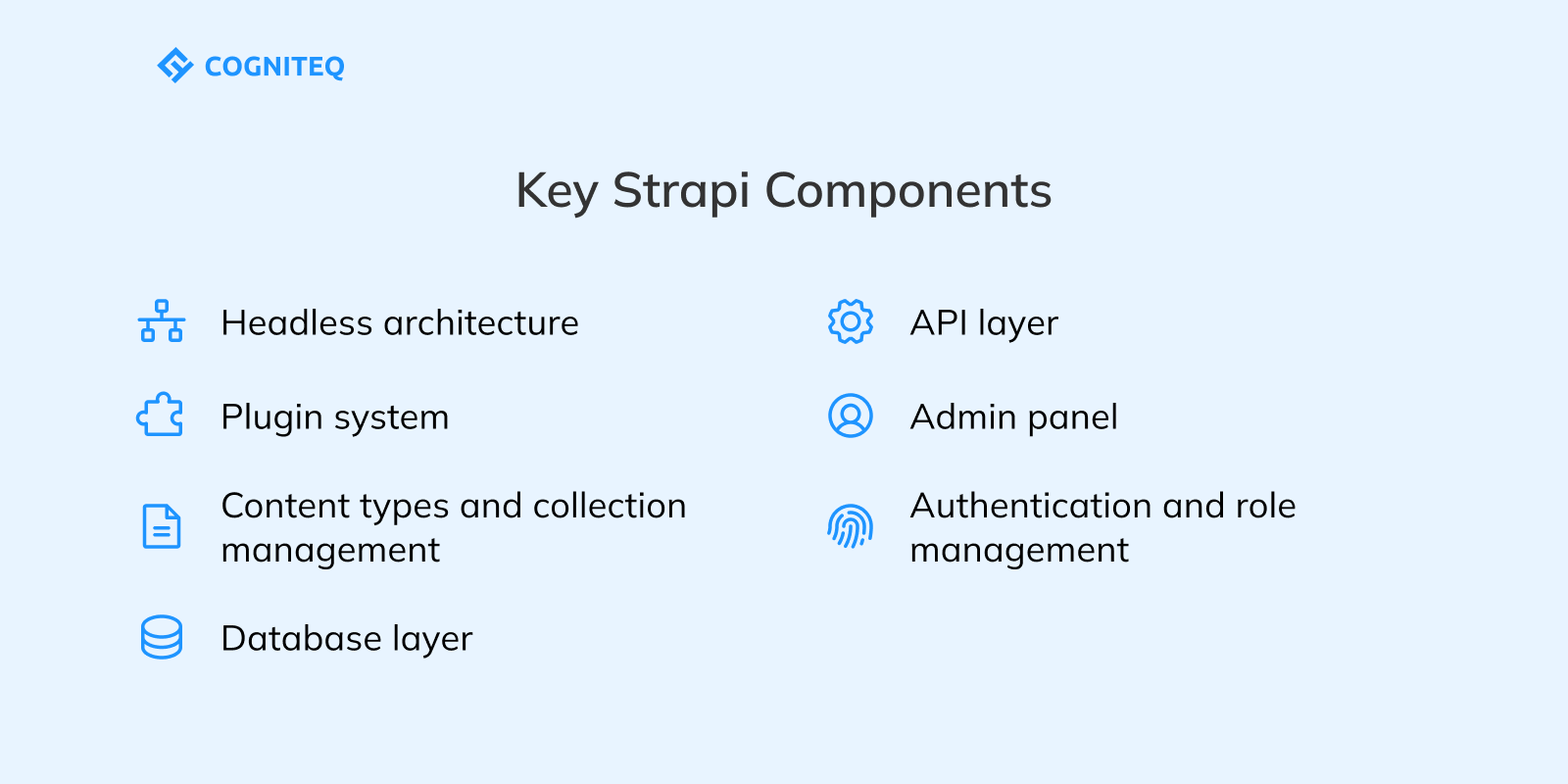
- Headless architecture. Strapi’s architecture is well-suited for multi-platform or omnichannel applications where content needs to appear consistently across web, mobile, and IoT devices.
- Content types and collection management. Strapi allows teams to define Content Types (articles, users, products, etc.) with the help of its visual Content-Type Builder. These types are automatically converted into structured database schemas, complete with endpoints and APIs.
- API layer. Every piece of content in Strapi is accessible through automatically generated REST or GraphQL APIs. Developers can extend or customize endpoints, add middleware, and apply logic to meet specific project needs.
- Plugin system. Strapi is built around a modular plugin system. Core functionalities, including authentication, media library, etc., are implemented as plugins. Moreover, developers can create their own plugins to extend functionality.
- Admin panel. This element provides creators and editors with all the required tools to manage content at all the steps, from creating entries to organizing media. It’s fully customizable. The panel allows teams to add new fields and tailor workflows to specific roles.
- Database layer. Strapi supports multiple databases. Among the supported databases are PostgreSQL, MySQL, MariaDB, and SQLite. This layer seamlessly integrates with Strapi’s content structure.
- Authentication and role management. The Strapi platform includes built-in JWT-based authentication, user roles, and permissions. Admins can define what each role can view, edit, or publish.
What is Strapi custom development?
Strapi development services cover the full lifecycle of building, customizing, and maintaining headless solutions tailored to specific business needs. Here is what such services typically include:
- Consulting and architecture design. Before development begins, experts help you define your content model, data structure, and system architecture, as well as provide technology stack recommendations.
- Strapi custom development. Developers build tailored APIs, content workflows, and backend logic.
- Plugin and feature development. Strapi experts can create or customize plugins that add new functionality to the CMS.
- Frontend integration. A development team can integrate the CMS with React, Next.js, Vue, Angular, or mobile frameworks like React Native or Flutter.
- Third-party integrations. Strapi connects with payment gateways (Stripe, PayPal), marketing platforms (HubSpot, Mailchimp), cloud storage (AWS, Cloudinary), and analytics solutions (Google Analytics, Segment).
- Migration to Strapi. If you already have a solution that works on a traditional CMS, developers can help you transfer content, users, and other assets to Strapi. To learn more about the benefits of such efforts, you can read our article on headless CMS migration.
- Strapi hosting and deployment. Strapi can be deployed on AWS, Google Cloud, Azure, DigitalOcean, or Strapi Cloud. A development team can help you with CI/CD setup, environment management, and optimization for performance, scalability, and security.
- Maintenance and support. After the launch of your solution, you can rely on Strapi experts for ongoing maintenance, version upgrades, bug fixes, and performance monitoring.
Are you looking for Strapi experts?
Our team builds secure, scalable, and high-performing Strapi solutions for businesses with different needs. Let’s discuss your project!
Strapi pros and cons: What you should know
Before making up your mind on whether Strapi development services will be a good option for you, you should fully realize the strengths and weaknesses of this CMS. Like any technology, Strapi shines in certain scenarios but may present challenges in others. Let’s take a closer look at both the advantages and disadvantages of Strapi.
Advantages of Strapi
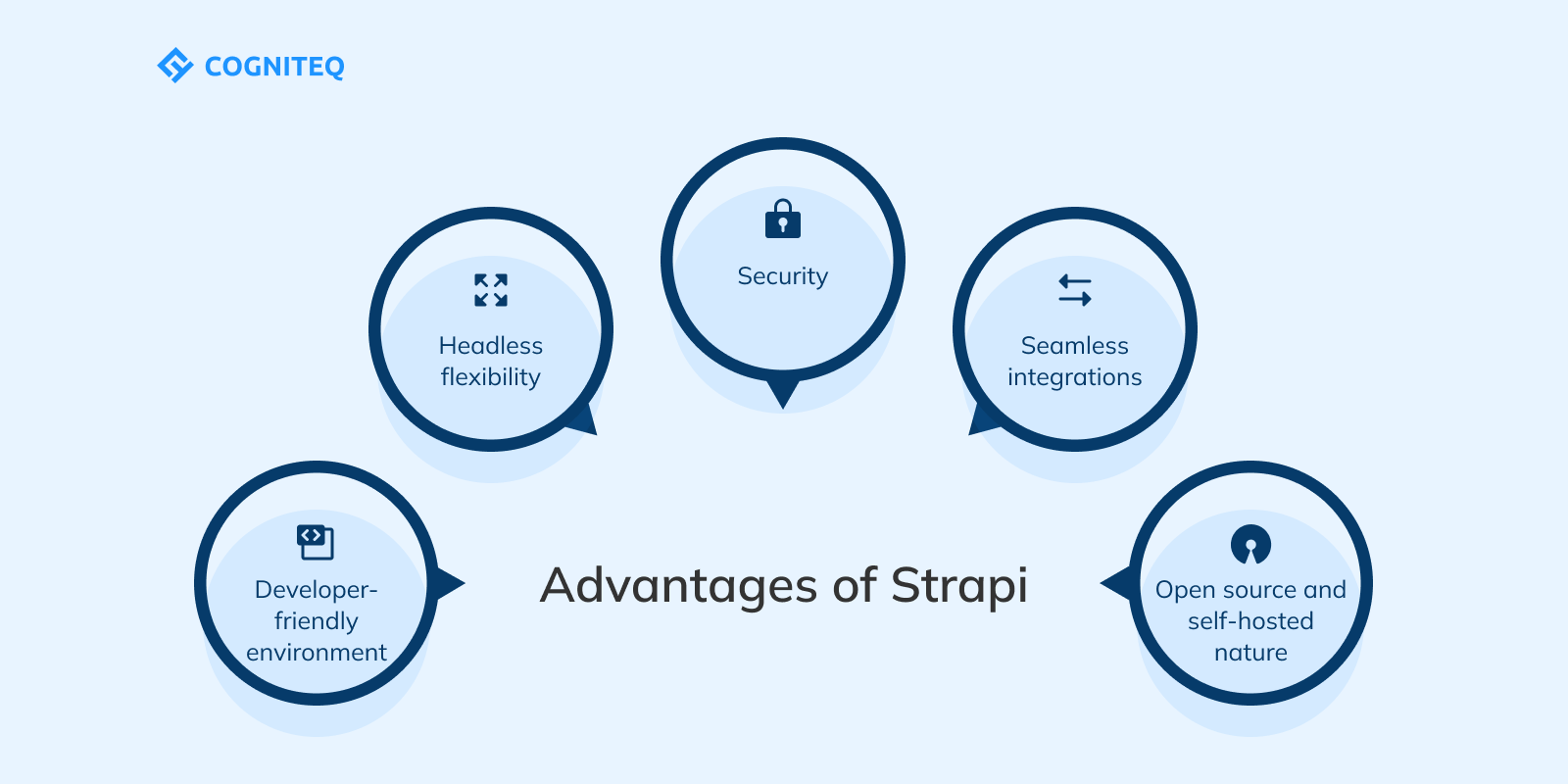
- Headless flexibility. Strapi’s headless architecture will allow you to deliver content to any platform (web, mobile, or IoT) through APIs. This gives developers complete freedom to choose powerful frontend frameworks like React, Vue, or Next.js.
- Open source and self-hosted nature. Thanks to being an open-source CMS, Strapi provides you with full control over your data, codebase, and hosting environment. You can customize it based on all your specific business needs and also contribute to the community-driven ecosystem on your own.
- Developer-friendly environment. Strapi is built with Node.js. It offers a modern developer experience, including a clean admin interface, REST and GraphQL APIs, and a large plugin system. The use of this headless CMS significantly reduces backend coding time.
- Seamless integrations. With its modular design, Strapi can integrate easily with CRMs, eCommerce systems, and analytics tools via APIs. You can also build custom plugins to extend its functionality based on business requirements.
- Security. Strapi comes with role-based access control, authentication, and permission systems out of the box. All this will help you maintain secure user and content management flows.
Disadvantages of Strapi
- Learning curve for non-developers. While the admin panel is intuitive, some technical background is needed to set up, customize, and deploy Strapi. That’s why, unlike traditional CMS platforms, such as WordPress, Strapi requires some specific skills and knowledge from its users. This can become a serious obstacle for non-tech specialists.
- Limited out-of-the-box templates. Strapi focuses mainly on backend content management. Given this, you will need to build your own frontend or integrate with a framework. This adds flexibility but also extra initial work for your development team.
- Hosting and maintenance responsibility. As this CMS is self-hosted, you are in charge of deployment, scaling, and updates. For teams without DevOps experience, this can add complexity. Nevertheless, the Strapi Cloud managed services help simplify these tasks.
- Limited plugin ecosystem. Strapi supports plugins and extensions. However, its marketplace is smaller compared to mature CMS platforms. For instance, if you make Strapi vs Sanity or Strapi vs Contentful comparisons, Strapi won’t be able to win in this aspect. Some specific functionalities may require custom development.
Strapi vs traditional CMS: Which is the best option for your project?
When our customers are choosing technology for managing their content online, comparisons like Strapi vs WordPress or Drupal are quite common. And it is quite natural, as one of the first decisions that you should make is whether you will rely on a headless or traditional CMS. Your solution should be based on a range of factors, including your project’s goals, flexibility needs, and long-term growth plans.
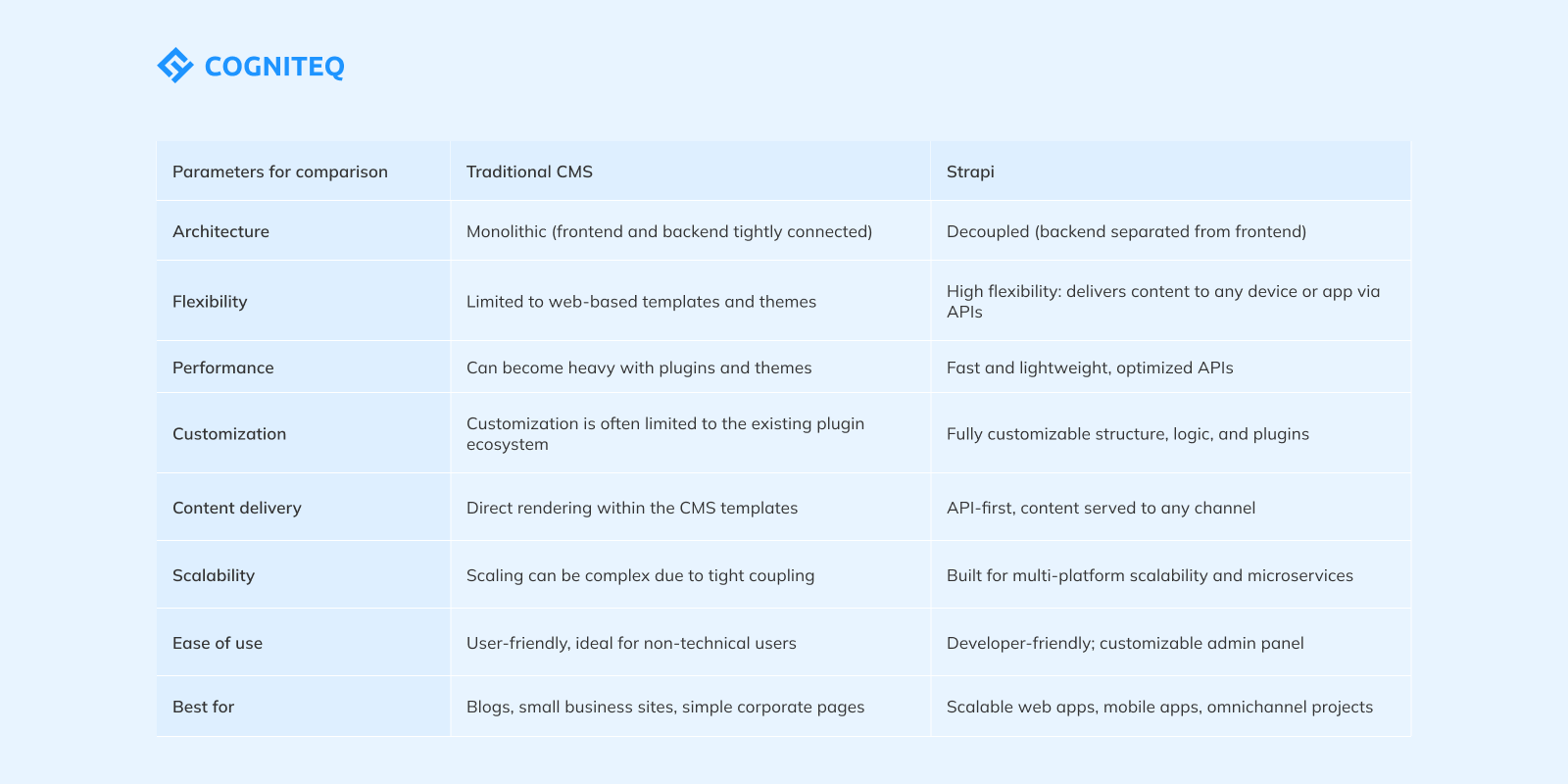
Traditional CMS platforms are monolithic systems. They handle both the frontend and the backend of your software under one umbrella. They are a suitable option for simple websites or blogs where quick setup and predefined themes are highly valuable.
However, their tightly coupled architecture can limit flexibility. This is a serious limitation for those companies that build custom digital experiences across multiple platforms, such as mobile apps, IoT devices, or custom web applications.
As Strapi takes a headless approach, it separates content management from content delivery. You can use its API to serve structured data to any frontend or device. At the same time, developers have complete freedom to choose frameworks like React, Vue, or Next.js. This makes Strapi a preferable choice for modern, scalable projects that need to serve content across different platforms (and it can be done from one backend).
The table below contains the key differences between traditional content management systems and the Strapi headless CMS.
Strapi custom development: Best practices and Cogniteq’s expertise
Based on our experience in delivering Strapi development solutions, we have prepared a list of practical recommendations that will help you fully leverage Strapi’s flexibility and keep your project scalable and secure.
- Carefully define your content architecture. Identify what content types, relations, and fields your project requires. Changing your schemas during the development process can lead to additional challenges later.
- Use environment-specific configuration for keys, API URLs, and database connections. This ensures better security and smoother deployment.
- Build custom plugins for any additional features you may need, like dashboards, integrations, or automation tools, instead of modifying Strapi’s core. This approach will help you keep your main app stable, when you will need to upgrade separate features.
- Implement role-based access control. We recommend that you use Strapi’s built-in Roles & Permissions to restrict access to sensitive APIs and admin actions. Regularly audit your permissions and introduce changes if needed.
- Don’t forget to update Strapi and its dependencies to benefit from new features, security patches, and performance improvements.
Today, in our portfolio, you can also find projects that included Strapi CMS development services. For example, one of the clients that we worked with wanted to launch a mobile wellness platform. The solution had to provide a wide range of features aimed at improving the mental state of users and helping them manage stress. The app delivers personalized daily challenges across several areas, such as mindfulness, sleep, digital balance, social connection, nutrition, and movement. Each activity combines interactive content, audio guidance, and gamified progress tracking.
Given the complexity of the content that this app was expected to deal with, it was necessary to find a reliable technology for managing it. After considering different options, we chose Strapi as it perfectly addresses the project’s needs.
The custom-built admin panel enables content editors to create new quests, adjust logic, manage tags and badges, send push notifications, and update content in real time. It is important to highlight that all these possibilities are available to non-technical users without developer involvement.
Helpful resources for your next Strapi custom development project
Strapi is known for its active developer community and a rich ecosystem of tools. If you are starting your journey with this CMS, it can be useful for you to turn to some of the available resources that will help you learn and extend the platform efficiently.
- Official Strapi resources. The official Strapi website offers comprehensive, regular updates, tutorials, as well as case studies.
- YouTube channels. Community creators post videos where they share interesting tips and live coding sessions.
- Dev.to articles. Such articles often contain practical recommendations for migration and integration.
- Udemy and Frontend Masters courses. These platforms provide learning paths for teams that start headless CMS development.
- Discord community. On Discord, you can find real-time discussions, project showcases, and help from other developers.
- Stack Overflow. This platform provides active Q&A threads for technical issues and debugging.
Wrapping up
The right choice of a CMS for your project is the foundation of stable and secure content delivery to the users of your solutions. Strapi is a flexible CMS that gives teams full control over how content is created, structured, and managed. Its open-source nature and API-first approach make it an excellent option for modern digital products that need scalability and customization. Nevertheless, this CMS still has some limitations. For example, it won't be the best decision to use it in projects that require a quick setup.
If you are looking for professionals who can provide you with Strapi CMS development services, contact us! At Cogniteq, we have solid expertise in working with headless CMS platforms and will be able to find the best solution for your specific business needs.
FAQ
Can Strapi development services be chosen for building eCommerce or mobile apps?
Yes, Strapi is a flexible headless CMS, and it can be suitable for creating eCommerce platforms and mobile applications. It can help you manage products, users, orders, and content from a single backend. You can connect this CMS with any frontend framework (React, Vue, Next.js, React Native, and others) or eCommerce platform like Shopify or Snipcart. This will help you deliver a fully customized user experience.
Is it secure to use Strapi?
This CMS provides security measures, like role-based access control, token-based authentication, and HTTPS support. It also enables developers to fine-tune permissions and efficiently protect API routes. All this is crucial for preventing unauthorized access. Strapi ensures a secure foundation. However, when it comes to Strapi development services, overall security will also largely depend on your hosting setup, regular updates, and the DevOps practices applied by your team.
What databases does Strapi support?
Strapi supports several popular databases, including PostgreSQL, MySQL, MariaDB, and SQLite. This flexibility allows teams to choose the database that best fits their performance, scalability, and hosting requirements. Nevertheless, please note that this CMS doesn’t natively support NoSQL and cloud-native (Google Cloud SQL, Amazon Aurora, etc.) databases.
Does Strapi provide different hosting options?
Yes, Strapi is self-hosted and open-source. Thanks to this, you can deploy it on any environment, including cloud servers (AWS, Azure, Google Cloud), container platforms (Docker, Kubernetes), and traditional shared hosting. For faster deployment, this headless CMS also offers Strapi Cloud. It is a managed hosting option that handles infrastructure and scaling for you.
Is Strapi a good choice for large-scale enterprise projects?
Yes, Strapi can be used for such projects as well. This CMS offers features like API customization, plugin extensions, caching, and high availability support. Its modular architecture makes it easy to integrate with other enterprise systems, including CRMs, ERPs, or marketing platforms.
Does Cogniteq offer custom Strapi plugin development or integrations?
Our team provides a full range of custom development services for Strapi. Our developers can extend its functionality and add new features, dashboards, or workflows. It is also possible to integrate Strapi with third-party services such as payment gateways, analytics tools, marketing platforms, or AI APIs. With our expertise in this field, we can tailor the Strapi CMS to all your specific business processes.
How long does it take to create a custom solution on Strapi?
Development time depends on the complexity of your future solution and the size of the team that will work on your project. However, the use of Strapi can significantly speed up the process. It provides an intuitive admin panel, while the plugin ecosystem reduces the volume of repetitive work. A basic setup with custom content types and APIs can be ready in a few days. Nevertheless, enterprise-level projects may take several weeks or months.