In today’s digital landscape, managing content efficiently across multiple platforms is more important than ever before. Traditional CMS platforms often do not have enough capabilities. And headless content management systems, such as Sanity CMS, are a good alternative. They separate content from presentation and provide teams with complete control over how and where their content is delivered.
Given all the opportunities that this platform can offer, it is quite natural that the popularity of Sanity development services is continuously growing. However, is Sanity a universal solution that can be used for absolutely all types of projects? That’s one of the questions that we will answer in our article. We will discuss the key features and advantages that set the Sanity headless CMS apart from the competition. But we will also mention its limitations so that you can make a well-grounded choice.
What is Sanity CMS?
Sanity is a headless content management system. It is designed to give developers and content creators complete flexibility over how digital content is structured and delivered.
Traditional CMS platforms tie content directly to a website’s front end. The Sanity headless CMS decouples the backend content repository from the presentation layer.
Thanks to this architecture, teams can distribute content seamlessly across different channels, including multiple websites, mobile apps, digital displays, and IoT devices.
Meanwhile, Sanity’s real-time database allows for instant collaboration. As a result, multiple editors and developers can work simultaneously without conflicts or delays.
Sanity CMS overview: Key features
Let’s take a closer look at the possibilities that are ensured by Sanity’s functionality.
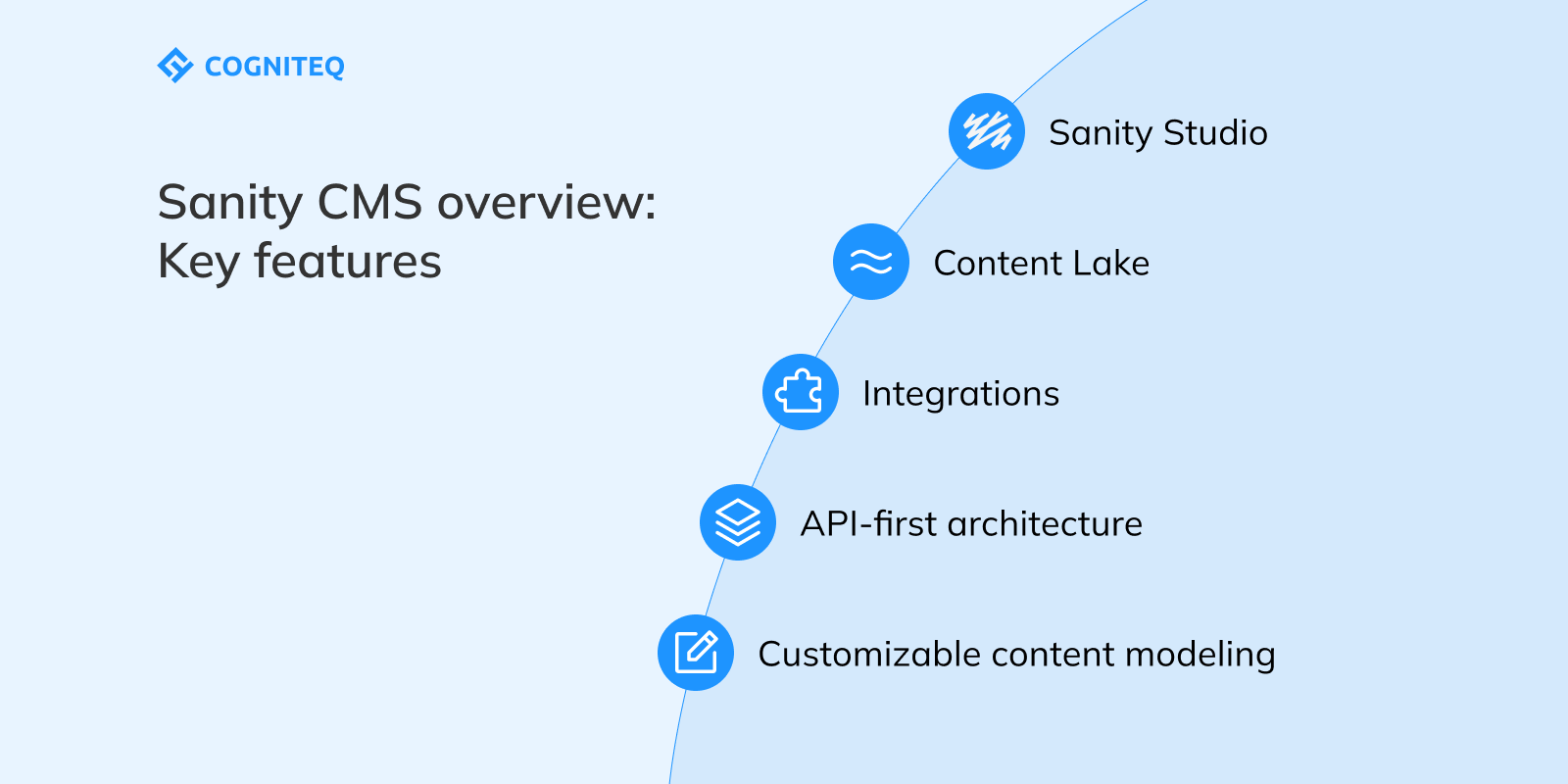
Sanity Studio
The Sanity Studio is the core component of this CMS. It is an open-source, fully customizable editing environment built with React. With its help, teams can define their own content schemas, workflows, and design layouts to ensure they fully match their unique project needs.
Any changes made in Sanity Studio are reflected immediately across all connected frontends. Thanks to this, all users always see the most up-to-date content.
Customizable content modeling
When using Sanity, developers are not locked into predefined content types. They can define their own data structures using simple JavaScript or TypeScript. This flexibility allows teams to model content in a way that fits their project’s unique requirements. Each schema identifies what fields will be included in the content (such as text, media, or custom objects), how those fields relate to one another, and how editors can interact with them inside Sanity Studio.
API-first architecture
Sanity is known for its API-first model. Thanks to this approach, it can integrate with popular frameworks like Next.js, React, Vue, and others. This gives developers full control over frontend experiences while structured and reusable content is maintained in the backend.
Content Lake
Content Lake should also be named among the most important Sanity CMS features. It is a cloud-hosted, real-time datastore. It stores all structured content and assets in a format that can be instantly queried and delivered via APIs. It supports Sanity’s own query language, which is known as GROQ (Graph-Relational Object Queries). It lets developers filter and reshape data with exceptional precision.
Integrations
Sanity integrates seamlessly with a wide range of modern tools and frameworks, which provides great flexibility for developers and content teams. It works with frontend frameworks such as Next.js, React, Nuxt, etc., and can ensure dynamic web experiences.
For deployment and hosting, Sanity connects with platforms like Vercel and Netlify. It integrates with Shopify for headless e-commerce setups. At the same time, integration with Algolia enables fast on-site search capabilities.
In addition, Sanity’s robust API and plugin ecosystem make it simple to connect with marketing tools, analytics platforms, and custom internal systems.
Benefits and Limitations of the Sanity headless CMS
When you are considering any technology or tool for your project, it is important to realize all its strengths and limitations to find the optimal balance between them and your technical needs. Based on our practical experience as a Sanity CMS development agency, we have summarized the most important pros and cons of using this content management system.
Advantages of the Sanity headless CMS
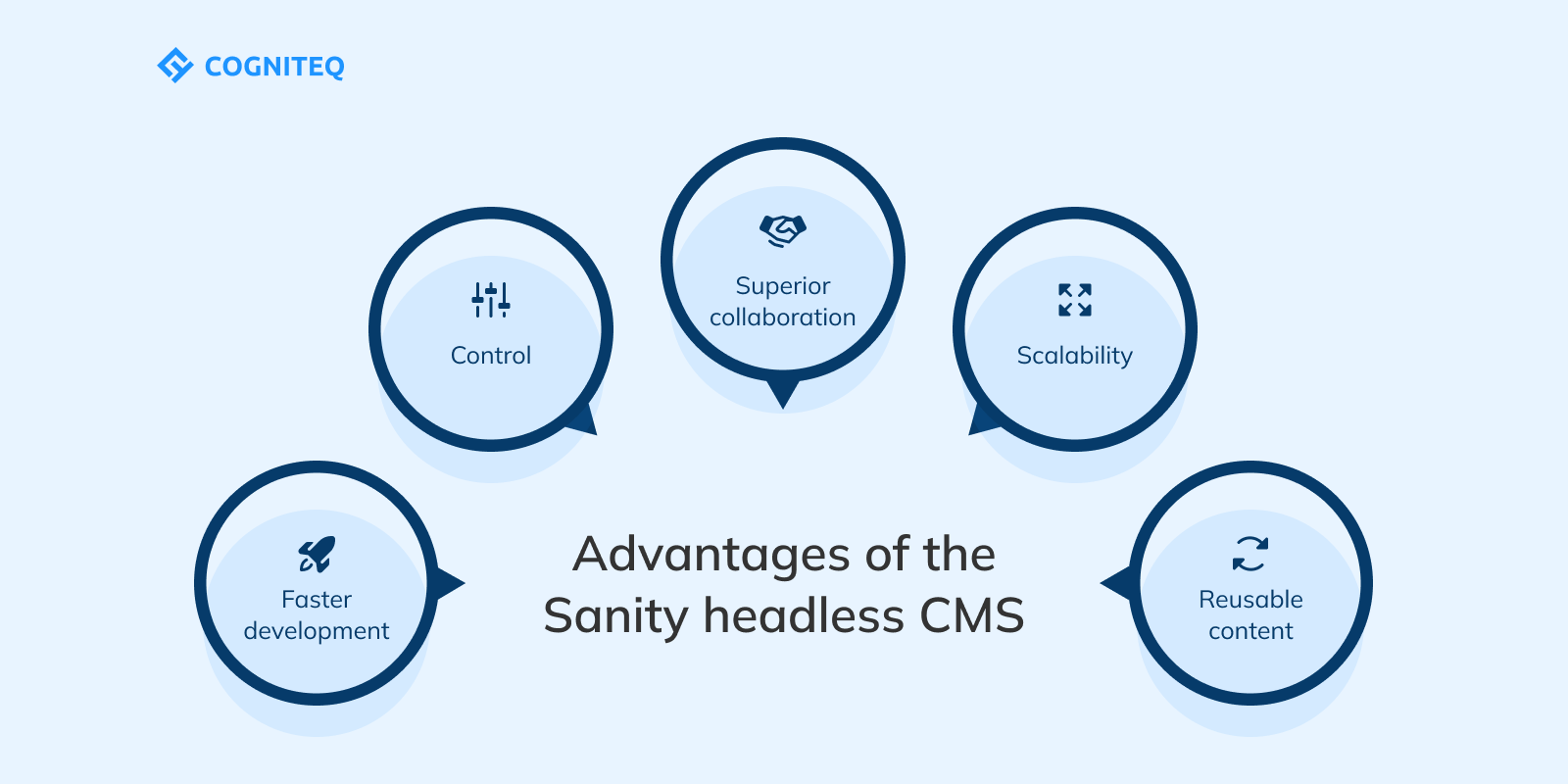
- Control. Developers have full control over content structure, workflows, and front-end presentation.
- Scalability. Sanity’s architecture can support different types of solutions, from small websites to enterprise-level platforms that need to deal with millions of API calls.
- Superior collaboration. This CMS provides a wide range of features that facilitate workflows for distributed content teams. This functionality includes real-time editing, version control, and user roles.
- Faster development. The use of Sanity allows teams to optimize development and setup time by leveraging prebuilt APIs, schema definitions, and seamless integrations.
- Reusable content. Content is stored in a structured format. Thanks to this, it can be reused across multiple platforms and applications.
Disadvantages of the Sanity headless CMS
- Learning curve. The use of Sanity requires some technical knowledge. Developers need to set up schemas and customize the studio effectively.
- Pricing. This CMS has a rather generous free plan, which can be fully sufficient for small projects. Nevertheless, the enterprise-level tier with advanced features can become costly.
- Limited ready-to-use functionality. Traditional CMS platforms come with prebuilt themes or templates. When you choose Sanity, everything must be developed from scratch. Though it can be viewed as a huge plus by some teams, for others, it means extra work and time required for launching their solutions.
- GROQ query language. GROQ is a powerful option. However, it can take time for developers to learn it, as the majority of specialists are usually familiar with more widely used GraphQL or REST queries.
Looking for a professional Sanity CMS development team?
At Cogniteq, we are always ready to support you with your project! With our solid expertise in working with headless content management systems, you will be able to fully leverage all the benefits of Sanity.
Sanity and other headless CMSs: Comparison
Today, there are several big players in the headless CMS market. All the systems are not just the same. Though they share the key features, they also have their own peculiarities that make them suitable for different use cases. That’s why it's crucial to understand these differences to know when it's better to opt for Sanity and in what cases a Sanity CMS alternative will be a more efficient solution.
Sanity vs. Contentful
Contentful is one of the most established headless CMS platforms. It is often praised for its stability and polished interface. However, in comparison with this CMS, Sanity offers a higher level of customization and developer flexibility through its open-source Sanity Studio.
Contentful relies on predefined content types and a more rigid structure. At the same time, Sanity allows you to define schemas. Additionally, Sanity’s real-time collaboration and Content Lake architecture offer a more dynamic editing experience than Contentful’s API-driven updates can ensure.
Contentful is a better choice if you need a plug-and-play enterprise CMS. But Sanity provides higher customization and more freedom for developers.
Sanity vs. Strapi
Strapi is an open-source, self-hosted CMS. As a result, it typically becomes a preferable platform for developers who want to have complete control over their infrastructure. Strapi provides flexibility in hosting and customization. But at the same time, it requires ongoing maintenance and security management. Currently, Strapi can also offer a managed cloud option. However, in this case, customization possibilities are limited.
Want to learn more about it? Read a Strapi guide on our blog!
Sanity offers a fully managed cloud infrastructure with automatic scaling and security. With its Content Lake, developers can enjoy data reliability without the operational overhead of server management.
It means that Strapi will suit you if you prefer a self-hosted approach and you have DevOps resources. Meanwhile, if you are looking for a maintenance-free and cloud-native platform, consider Sanity.
Sanity vs. Storyblok
Storyblok is known for its visual editor. It allows content teams to preview changes in real time. It’s particularly popular among marketing teams and designers as they value a visual-first editing experience.
Though Sanity doesn’t offer a traditional drag-and-drop visual editor, it provides structured content modeling and developer flexibility. Sanity’s schema-driven approach gives teams deeper control over how content is structured and reused across multiple platforms.
Storyblok’s component-based editor is an appropriate platform for non-technical users. Sanity requires tech skills but provides great flexibility.
The table below contains the key facts about the mentioned content management systems so that you can analyze the most significant differences faster.
Use cases for the Sanity headless CMS
As a Sanity CMS development agency, we are strongly confident that Sanity can be a suitable option for a wide range of projects of various types and sizes. This content management system is designed to ensure great flexibility. And the list of possible use cases is a great proof of this fact. What solutions can be built with the Sanity headless CMS?
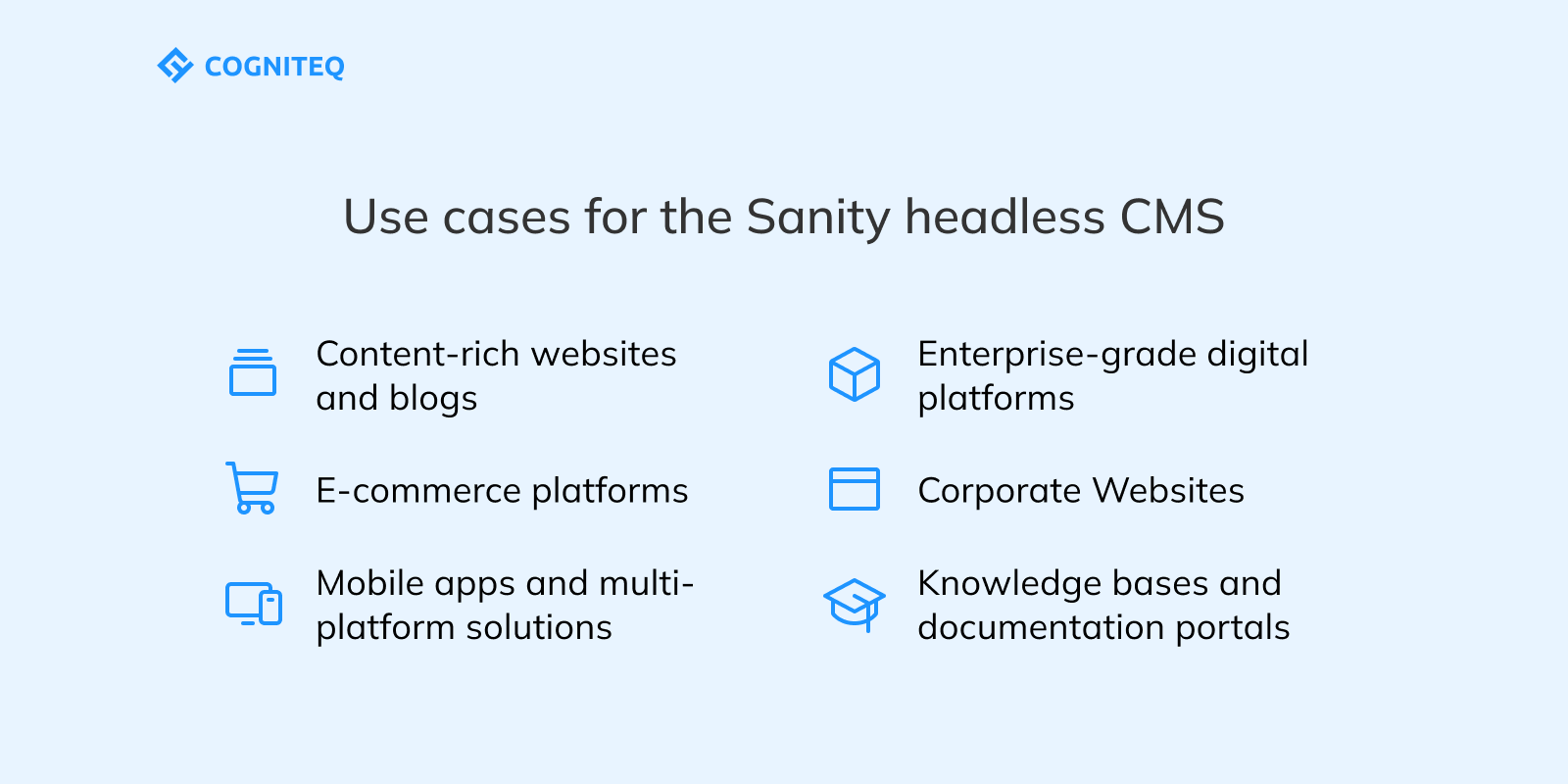
Content-rich websites and blogs
Sanity is well-suited for managing complex editorial workflows and large content libraries. That’s why publishers and media teams can use Sanity Studio to structure articles and manage media assets. With Sanity, you can model any content type (news, guides, case studies, product stories, etc.) exactly as needed, without any constraints typical of traditional CMS templates. Apart from this, Sanity provides powerful collaboration tools, which make the work for distributed teams convenient and efficient.
E-commerce Platforms
With seamless integrations to Shopify, Stripe, and Algolia that are widely used by e-commerce projects, Sanity can serve as the content backbone for such platforms. It allows teams to manage rich product data and landing pages independently of the frontend store. This enables faster site performance and better SEO, as well as more freedom in designing customer experiences across web and mobile channels.
Corporate Websites
Marketing teams can benefit from Sanity’s functionality, such as real-time collaboration tools, version control, and customizable content workflows. Moreover, thanks to the provided features, brands can update their landing pages and campaign content without developer assistance. In addition to this, organizations can leverage smooth integrations for analytics, A/B testing, and personalization tools, which are highly valuable for growth-focused digital marketing.
Mobile apps and multi-platform solutions
Thanks to the fact that the Sanity headless CMS is API-first, it is good for managing content that needs to appear across multiple channels. Its Content Lake enables developers to deliver structured data consistently and in real time. This ensures unified experiences across all digital touchpoints.
Knowledge bases and documentation portals
Sanity’s structured content model and advanced querying make it a suitable CMS for documentation platforms or internal knowledge bases. Teams can organize technical content hierarchically and enable powerful search. This helps businesses ensure documentation remains up to date across different products or teams.
Enterprise-grade digital platforms
Enterprises use Sanity to manage massive amounts of content across global teams and markets. Its scalability and real-time APIs allow organizations to integrate Sanity into complex digital ecosystems. Moreover, this headless CMS also provides enterprise security features that ensure data integrity and compliance for organizations handling sensitive information.
Prominent businesses that rely on Sanity
The range of brands that build their platforms on Sanity or migrate their content to this headless CMS is continuously growing. Here are a couple of real-life examples of such businesses.
- Figma. This design collaboration platform relies on the Sanity headless CMS to manage its documentation, blog, and marketing content. The flexibility of Sanity’s content modeling allows Figma’s team to keep its design system consistent while scaling documentation for millions of users.
- PUMA. One of the top shoe brands has chosen Sanity to send its marketing and e-commerce content across channels. The key goal was to decouple content from its commerce platform and accelerate time-to-market. With Sanity, the company operates a unified backend for all its global properties and eliminates the inefficiencies of traditional content silos.
- Cloudflare. Cloudflare provides IT services, including a content delivery network, DDoS mitigation, and DNS. It uses Sanity CMS to manage technical documentation and developer resources. The platform’s content model ensures consistency across hundreds of product pages and maintains accuracy for continuous product updates.
Final word
Sanity CMS is a feasible choice for modern content management. Its flexible content modeling, real-time collaboration, and seamless integrations enable developers and content teams to deliver engaging experiences across multiple channels.
As a Sanity CMS development company, Cogniteq helps businesses build and scale robust content infrastructures tailored to their unique requirements. With strong practical skills in working with Sanity, our experts will ensure you get the most out of Sanity’s headless architecture.
Want to learn more? Book a call with our team to discuss your needs and possible solutions.
FAQ
What is Sanity CMS?
It is a headless content management system. Unlike traditional CMSs, it separates content creation from presentation. It allows teams to manage structured content through a highly customizable editing interface named Sanity Studio. The content is stored in a cloud-based platform and delivered via APIs to any frontend. Thanks to this architecture, developers maintain full control over how content is displayed. At the same time, editors and content managers can leverage great flexibility.
Why is Sanity often named the best headless CMS in 2025?
The Sanity headless CMS stands out for its flexible content modeling and powerful developer tools. Its powerful features make it faster and more efficient than many competitors. Its open-source Sanity Studio and a generous free plan are among other benefits that make it a good option for businesses of different types, including startups and large enterprises.
What are the main differences between Sanity, Contentful, and Strapi?
Compared to Contentful, Sanity offers greater customization and more convenient real-time collaboration tools. Contentful is known for its enterprise reliability. At the same time, Sanity ensures more freedom for developers. As for Strapi, it supports cloud and self-hosting models. The latter option ensures great flexibility but requires more maintenance than Sanity, which provides a fully managed cloud backend. The choice of the best headless CMS typically depends on project requirements and the right balance between control and ease of use.
Is Sanity a good option for development teams and content editors?
Yes, Sanity has features that are helpful and convenient for different categories of users. Developers benefit from its schema customization and robust APIs. Meanwhile, editors can enjoy a clean interface with real-time updates and collaboration features.
What are the main advantages of using the Sanity headless CMS?
Sanity ensures great flexibility, scalability, and speed. Its structured content model enables teams to reuse data across platforms without any difficulties. The range of benefits also includes real-time collaboration features, a fully customizable editing studio, and an API-first approach. All this is important for modern web and app development. Sanity can also be seamlessly integrated with popular frameworks, like React, Next.js, and Vue, which helps reduce development time and optimize costs.
In what types of projects can we use Sanity?
It would be a good idea to partner with a Sanity CMS development agency for content-heavy, dynamic projects that require flexibility. For example, Sanity is often chosen for marketing websites, e-commerce platforms, editorial sites, and digital product catalogs. It can also address the needs of projects that are expected to deal with consistent content flows across multiple channels or platforms.
How can Sanity ensure scalability for large enterprises?
This CMS uses a reliable cloud infrastructure that scales automatically. It can support high traffic and complex content structures. Its global CDN and real-time APIs enable fast data delivery regardless of project size. The Enterprise plan includes custom roles and access control, as well as dedicated support and uptime SLA.
Is it possible to integrate Sanity with frameworks like Next.js and React?
Yes, Sanity supports seamless integrations with modern JavaScript frameworks, including Next.js and React. Its flexible APIs make it easy to render structured content on any frontend. Thanks to this, developers can quickly build dynamic applications with real-time capabilities and a scalable backend.